Showing posts with label Coming of Age. Show all posts

Thursday, June 23, 2022

Review - - Here for the Drama

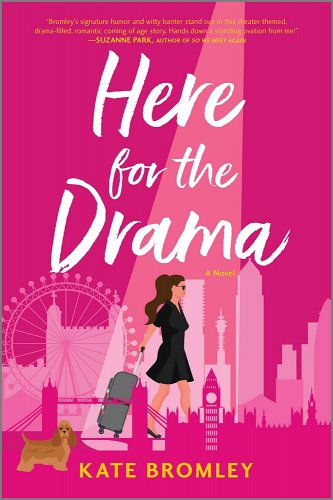
Here for the Drama
by Kate Bromley
Publisher: Graydon House
Release Date: June 21, 2022
Reviewed by Nancy


It wouldn’t be the theater without a few theatrics…


Becoming a famous playwright is all Winnie ever dreamed about. For now, though, she'll have to settle for assisting the celebrated, sharp-witted feminist playwright Juliette Brassard. When an experimental theater company in London, England, decides to stage Juliette's most renowned play, The Lights of Trafalgar, Winnie and Juliette pack their bags and hop across the pond. 

But the trip goes sideways faster than you can say "tea and crumpets." Juliette stubbornly butts heads with the play's director and Winnie is left stage-managing their relationship. Meanwhile, Winnie's own work seems to have stalled, and though Juliette keeps promising to read it, she always has some vague reason why she can't. Then, Juliette's nephew, Liam, enters stage left. He's handsome, he's smart, he is devastatingly British…and his family ties to Juliette pose a serious problem, forcing Winnie to keep their burgeoning relationship on the down-low. What could go wrong?

Balancing a production seemingly headed for disaster, a secret romance and the sweetest, most rambunctious rescue dog, will Winnie save the play, make her own dreams come true and find love along the way—or will the slings and arrows of outrageous fortune get the best of her?


***This review contains spoilers ***


Nancy says: 

I wanted to love this book. It appeals to my interest in England and my enjoyment of theater, and it has a dog. In the end, I came away with mixed feelings. There were many things I liked about this story but some that just seriously didn’t work for me. 

On the plus side, Winnie is hard-working, loyal, and affectionate. Her insecurity about the play she’s trying to write is explained well, making it believable and sympathetic. Liam is a nice guy who has had a rough time lately despite business success. He’s at loose ends personally but for understandable reasons. 

Juliette generally comes across well despite being a bit self-centered, and Roshni, her other assistant, is a lively, warm, loyal and encouraging friend to Winnie. In fact, I would say she’s Winnie’s closest friend based the way the two interact. That was one of my problems with the ending. 

The other supporting characters, the play’s director, her partner, and the cast have minor roles, but the director really shines. She’s professional, talented, and not intimidated by Juliette’s fame. She’s also helpful to Winnie in a way Juliette hasn’t been. 

Winnie’s first date with Liam is a lovely tour of London with beautifully written banter and more earnest conversation. 

On the downside, the story starts slowly. There’s more than I needed about Juliette’s career and Winnie’s stalled efforts as a playwright in the first two chapters. To me, the story really begins in London. The action picks up once the characters arrive there. 

Juliette gives her assistants the occasional great perk, such as tickets to a sold-out show, but doesn’t take much interest in them personally. She promises to help Winnie with her play but never follows through. That’s not bad in itself, especially since she’s not the heroine, but it’s part of my problem with the ending. 

Juliette more or less orders Winnie to go out blind dates via an app so Juliette can get stories that might break her out of whatever is stalling her playwriting efforts. Winnie agrees to go, although reluctantly. At one of these dates, Liam appears at the cafĂ© that’s the designated meeting place. When he finds out about the planned meeting, he sticks around and crashes it. Or he would’ve if Winnie hadn’t agreed to see him later. 

The banter between Winnie and Liam is generally great, but every once in a while, Winnie says something harsh that throws him off his stride. Yet this doesn’t lead her to moderate her approach. At one point, he drops by the flat where Winnie is working with Juliette, and Winnie thinks of him as a gigolo. This was not depicted as humorous and threw me off. He isn’t dating anyone else, she isn’t paying him to date her, and I saw no reason for applying that label to this nice guy. 

A neighbor offers to watch the stray dog Winnie rescued. Since Juliette knows his family, Winnie agrees. He seems like a nice guy until he mentions his fluffy pajamas and his bedroom slippers to her during their first conversation. Then she takes an interest in the slippers, tries them on and even borrows them. From this guy she just met. For me, this crosses a line on both their parts, and I found it off-putting. 

Juliette and her sister are estranged. When her sister, Isabelle, drops by in hopes of seeing Juliette, who isn’t home, she and Winnie talk some about the sisters’ shared history. At one point, Isabelle mentions her husband, and Winnie asks her whether Juliette liked him. That also crosses a line for me. If Winnie wants to know how Juliette once felt about her brother-in-law, she should ask Juliette. 

Winnie’s intrusive behavior grows worse. She learns Juliette had a serious relationship when she lived in England years before. When she and Juliette discuss it, Juliette seems to have nostalgic feelings about it. So Winnie decides to track down Juliette’s former love and lies to Liam to get him to help her.  She then asks the man questions about his history with Juliette.


---SPOILER ALERT---


Undercurrents between Winnie and Juliette erupt eventually, severing their relationship. Winnie goes on to success as a playwright, and Liam sets up a meeting between the two. Winnie and Juliette talk through their differences. Several years later, they’re on a more equal footing. All that is well done—until the moment Winnie says Juliette was her dearest friend. This didn’t work for me because Juliette hadn’t behaved like a good friend and had done some manipulative and underhanded things. 

No hint of their being good friends appears in the early part of the book, though a good relationship implicitly happens between the epilogs. If anyone in the book is Winnie’s closest friend, it’s her fellow assistant, Roshni. They support, encourage, and trust each other throughout. They keep each other’s secrets while Winnie is keeping secrets from Juliette. 

---END SPOILER---


The romantic ending is handled beautifully and is satisfying. The conflict between Winnie and Juliette, for the reasons noted above, is not. 

Near the end of the book, there is a lovely scene between Winnie and her stepmother, but it didn’t seem necessary to the overall story. While the book contains some references to Winnie liking her stepmother but regretting that they aren’t close, this isn’t a major element of the plot. 

Overall, there is much to like about these characters and the story. The relationship between Winnie and Liam develops nicely despite the occasional stumble. I had some serious issues, though, with the bits I didn’t feel worked well. Despite that, I do recommend the book, especially for Anglophiles and theater fans. 

3.5 Stars 

~Nancy


Monday, November 2, 2020

Tour Review - - The Wrong Kind of Woman

The Wrong Kind of Woman: A Novel
by Sarah McCraw Crow
Publisher: MIRA
Release Date: October 6, 2020
Reviewed by PJ


A powerful exploration of what a woman can be when what she 
should be is no longer an option

In late 1970, Oliver Desmarais drops dead in his front yard while hanging Christmas lights. In the year that follows, his widow, Virginia, struggles to find her place on the campus of the elite New Hampshire men’s college where Oliver was a professor. While Virginia had always shared her husband’s prejudices against the four outspoken, never-married women on the faculty—dubbed the Gang of Four by their male counterparts—she now finds herself depending on them, even joining their work to bring the women’s movement to Clarendon College.

Soon, though, reports of violent protests across the country reach this sleepy New England town, stirring tensions between the fraternal establishment of Clarendon and those calling for change. As authorities attempt to tamp down “radical elements,” Virginia must decide whether she’s willing to put herself and her family at risk for a cause that had never felt like her own.

Told through alternating perspectives, The Wrong Kind of Woman is an engrossing story about finding the strength to forge new paths, beautifully woven against the rapid changes of the early ’70s.

PJ's Thoughts:

Virginia is a product of her upbringing. Setting aside her own dreams when she married, she's spent the past several years supporting her husband as he pursues his academic goals and mothering their daughter. But suddenly, she's a 39-year-old widow in a patriarchal society on the cusp of upheaval. Where does she belong? How does she move forward without her husband? Who are her allies? With a 13-year-old daughter to protect and her financial security in the hands of men fighting to maintain the status quo, will she once again sacrifice herself for others or, this time, will she finally find her own voice? I found the character of Virginia very compelling and her journey, both insightful and realistic. 

Set against the turbulent landscape of the early 1970's, Sarah McCraw Crow has penned a thought-provoking debut novel about vividly portrayed, complex characters searching for their place in a changing world. Choosing a college campus for her setting was inspired as it provides a microcosm of what was happening across the United States at the time. It also allows for an organic intersection of characters that may not have so easily happened were it not for the classes and activities that naturally occur on campuses. 

I found the character of Sam particularly compelling. A brilliant but socially awkward college student struggling with the dissolution of his parents' marriage and his father's subsequent remarriage and new baby, his Jewish religion in a small, predominantly Christian school, and his internal struggles with his sexuality, he was ripe for the picking by those who did not have his best interests at heart. 

Virginia's daughter also is an interesting character, dealing with her father's death, the upheaval of her home life, confusing changes in her mother, and the hormonal challenges of most young teen girls. I have a feeling the author has, at some point, probably lived with a 13-year-old girl.  

The secondary cast of characters, especially the Gang of Four, highlight the hope, frustration, fear, and dedication of the women of this time who put everything on the line to fight for equality, and in many cases, basic human rights. They are fully developed characters who bring authenticity to the story.

I was a 19-year-old college sophomore in 1970, living with riots, sit-ins, campus streets occupied by armed National Guard, a National uneasiness, and, among females, growing frustration with a woman's place in society. It was a time of confusion, a time of upheaval, a time when a courageous segment of our female population began to take a stand, and a time that Sarah McCraw Crow has indelibly captured in The Wrong Kind of Woman

~~~~~~~

Sarah McCraw Crow grew up in Virginia but has lived most of her adult life in New Hampshire. Her short fiction has run in Calyx, Crab Orchard Review, Good Housekeeping, So to Speak, Waccamaw, and Stanford Alumni Magazine. She is a graduate of Dartmouth College and Stanford University, and is finishing an MFA degree at Vermont College of Fine Arts. When she's not reading or writing, she's  probably gardening or snowshoeing (depending on the weather).


Tuesday, November 11, 2014

Review - - Dollbaby

PJ here. Today, I take a step away from romance with a review of a beautifully written, thought-provoking story that captures the heart and touches every emotion therein.  Here are my thoughts on Dollbaby, the stunning new coming-of-age novel from Laura Lane McNeal. 


Dollbaby
By Laura Lane McNeal
Publisher: Viking
Release Day: July 3, 2014


It was the sultry, and tumultuous, summer of 1964 when Liberty "Ibby" Bell's mother unceremoniously dumped her in front of her grandmother's home in New Orleans with nothing more than a single suitcase and an urn holding her father's ashes then drove off to "find herself." Eleven-year-old Ibby had barely begun to come to terms with her beloved father's untimely death and here she was, in a strange city, foisted upon her father's mother - an eccentric woman she'd never met and, until a few years earlier, hadn't even known existed - not to mention her grandmother's black cook and the cook's smart-mouthed daughter. Ibby had never even seen a black person before! Life as she had known it would never again be the same.

Fannie Bell has lived in the old house on Prytania Street since she was a young bride; a house that has seen its fair share of joy and despair over the years. At one time, its walls reverberated with the laughter and running feet of exuberant children but for the past twelve years, since Fannie's dear son married "that woman" and moved north, it has only held painful memories of the past for a woman who battles untold demons. When her son's daughter appears on her doorstep, Fannie is determined to not waste the second chance she's been given but when her demons reappear it's up to Queenie and Dollbaby to hold things together.

Queenie has always known her place and been content with it. As Fannie's cook, she has done her best to keep the Bell household - and Miss Fannie - on track for more than thirty years. She probably knows Miss Fannie better than anyone; knows her strengths, her weaknesses, her secrets. It's Queenie who keeps things on an even keel but the unexpected arrival of Ibby has stirred things up within the old house on Prytania Street. And speaking of stirred up, Queenie's daughter Dollbaby is plenty stirred up. As a young woman of color, Dollbaby is not content with her lot in life. She's a woman with ambition, dreams and hidden resentments threatening to spill over.

In Dollbaby, Laura Lane McNeal has expertly crafted an enthralling coming-of-age story set amidst a time of social upheaval in the American south. Spanning a period of eight years, it follows the story of four women - two white, two of color - as they navigate the sometimes perilous, sometimes humorous and frequently poignant emotional waters of their complex, sometimes complicated relationships. Through the thoughts and actions of the characters, the reader is given insight into the challenges and injustices of the time which vary not only by color but by generation as well. I don't know if the author experienced the sixties first hand but, as someone who was slightly older than Ibby at the time the story takes place, I can tell you that she captured the mood of the nation exceptionally well.

But while the civil unrest of the sixties and the unique city of New Orleans are a rich backdrop for this story, it's the characters that provide the soul. Complex, multi-layered, fully developed characters with lessons to teach, lessons to learn, secrets to confront, truths to reveal, forgiveness offered...and love accepted. It's an enthralling, fascinating exploration of the complexities of class, race and gender in the pre-segregation south and how those facets are woven together to create the fabric of the relationship - no, of the family - formed by these women. It's a story you can sink your teeth into.

It's a keeper.

~PJ


Have you read Dollbaby? To me, it has the same rich southern flavor and evocative feel as Sue Monk Kidd's The Secret Life of Bees. Others have compared it to Kathryn Stockett's The Help

Do you enjoy coming-of-age stories?

Have you been to New Orleans? What's your favorite memory of the city?

I have a signed hard cover copy of Dollbaby for one randomly chosen person who leaves a comment today. (U.S. only)

Thanks to Nancy Berland at Nancy Berland Public Relations, Inc. for the giveaway copy.